
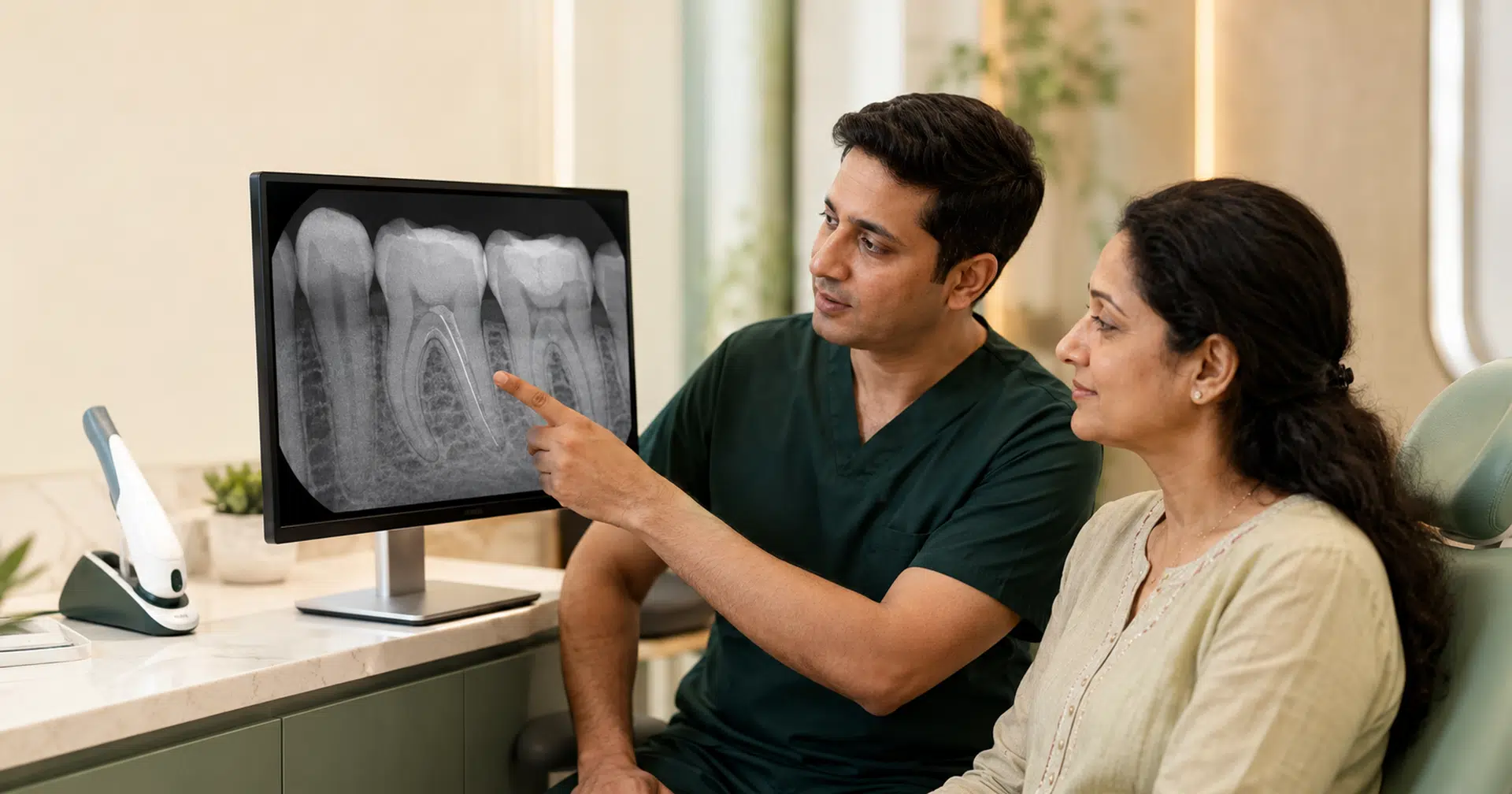
A tooth that seems beyond saving can often be successfully treated with proper diagnosis and advanced endodontic techniques. This clinical case involved a failed root canal, a fractured endodontic instrument, and an adjacent wisdom tooth that could not be restored.
The Patient’s Concern
A 41-year-old woman visited Dantam Dental Care with severe pain in her upper left back teeth for the past 15 days. She was finding it difficult to chew comfortably and wanted a permanent solution.
After a thorough clinical examination and digital X-rays, we identified two major problems.
The upper left wisdom tooth, tooth number 28, had extensive decay involving the buccal aspect and was considered non-restorable. The best treatment option for this tooth was extraction.
The adjacent tooth, tooth number 27, had previously undergone root canal treatment elsewhere. However, the X-ray revealed a fractured endodontic instrument lodged inside the root canal. This had contributed to persistent infection and the failure of the previous treatment.
We discussed the findings with the patient and explained the available treatment options, expected outcomes, and treatment timeline. Informed consent was obtained before beginning the procedure.
The First Appointment
During the first appointment, we removed the existing crown from tooth number 27. Tooth number 28 was then carefully extracted, and we initiated root canal retreatment for tooth number 27.
One of the most challenging parts of the procedure was retrieving the separated instrument from inside the canal. Using specialized endodontic techniques and magnification, we successfully removed the broken file during the same appointment. This allowed us to thoroughly disinfect the canal system.
The extraction site was then allowed to heal for approximately two weeks.
Completing the Root Canal Retreatment
At the next visit, we carried out an extensive irrigation protocol using standard endodontic disinfection procedures to eliminate any remaining bacteria and debris.
Once we were satisfied that the canals were completely clean and dry, we performed the final obturation, sealing the canals to prevent future infection.
Following the successful completion of the root canal treatment, a core build-up was performed to strengthen the remaining tooth structure.


Restoring the Tooth With a Crown
The tooth was prepared for a full-coverage crown and digitally scanned using our advanced TRIOS 3 intraoral scanner. This ensured excellent precision without the discomfort of conventional impression materials.
After discussing the available restorative options, the patient chose a Porcelain Fused to Metal (PFM) crown, balancing strength, durability, and affordability.
The crown was fabricated and delivered with an excellent fit, a proper bite, and pleasing function.
The Treatment Outcome
The entire treatment was completed in approximately 15 days.
The patient is now completely pain-free and able to chew comfortably. Most importantly, we were able to save a tooth that might otherwise have required extraction.
What This Case Demonstrates
Even when a previous root canal has failed, modern re-treatment techniques can often save the natural tooth. Early diagnosis, proper planning, and meticulous execution can make a remarkable difference to long-term success.
If you are experiencing persistent pain after root canal treatment or have been told that a tooth cannot be saved, do not lose hope. Every case deserves a thorough evaluation before a final decision is made.
Frequently asked questions
Can a tooth be saved after a root canal treatment has failed?
Even when a previous root canal has failed, modern retreatment techniques can often save the natural tooth. Every case requires a thorough evaluation before a final decision is made.
Why had the previous root canal treatment failed in this case?
The X-ray revealed a fractured endodontic instrument lodged inside the root canal of tooth number 27. This had contributed to persistent infection and the failure of the previous treatment
How was the fractured instrument removed from the root canal?
The broken file was successfully removed during the first appointment using specialized endodontic techniques and magnification. This allowed the canal system to be thoroughly disinfected.
Why was the adjacent wisdom tooth extracted?
The upper left wisdom tooth, tooth number 28, had extensive decay involving the buccal aspect and was considered non-restorable. Extraction was therefore the best treatment option.
How long did the complete treatment take?
The entire treatment, including extraction, root canal retreatment, healing time, core build-up, digital scanning, and crown delivery, was completed in approximately 15 days.
Which type of crown was used to restore the tooth?
The patient chose a Porcelain Fused to Metal (PFM) crown, balancing strength, durability, and affordability.